%201.webp)
The Podwalk app: step into history
The Podwalk app: step into history
The Podwalk app: step into history
In collaboration with production company Tuvalu Media and broadcaster NTR, Elements developed the Podwalk app for the series ‘The Story of the Netherlands’. The idea behind the app is not complicated, but it is completely new. Theun Termijtelen (Tuvalu) and Erwin van der Put (Elements) talk about the challenges involved in developing this innovative app.
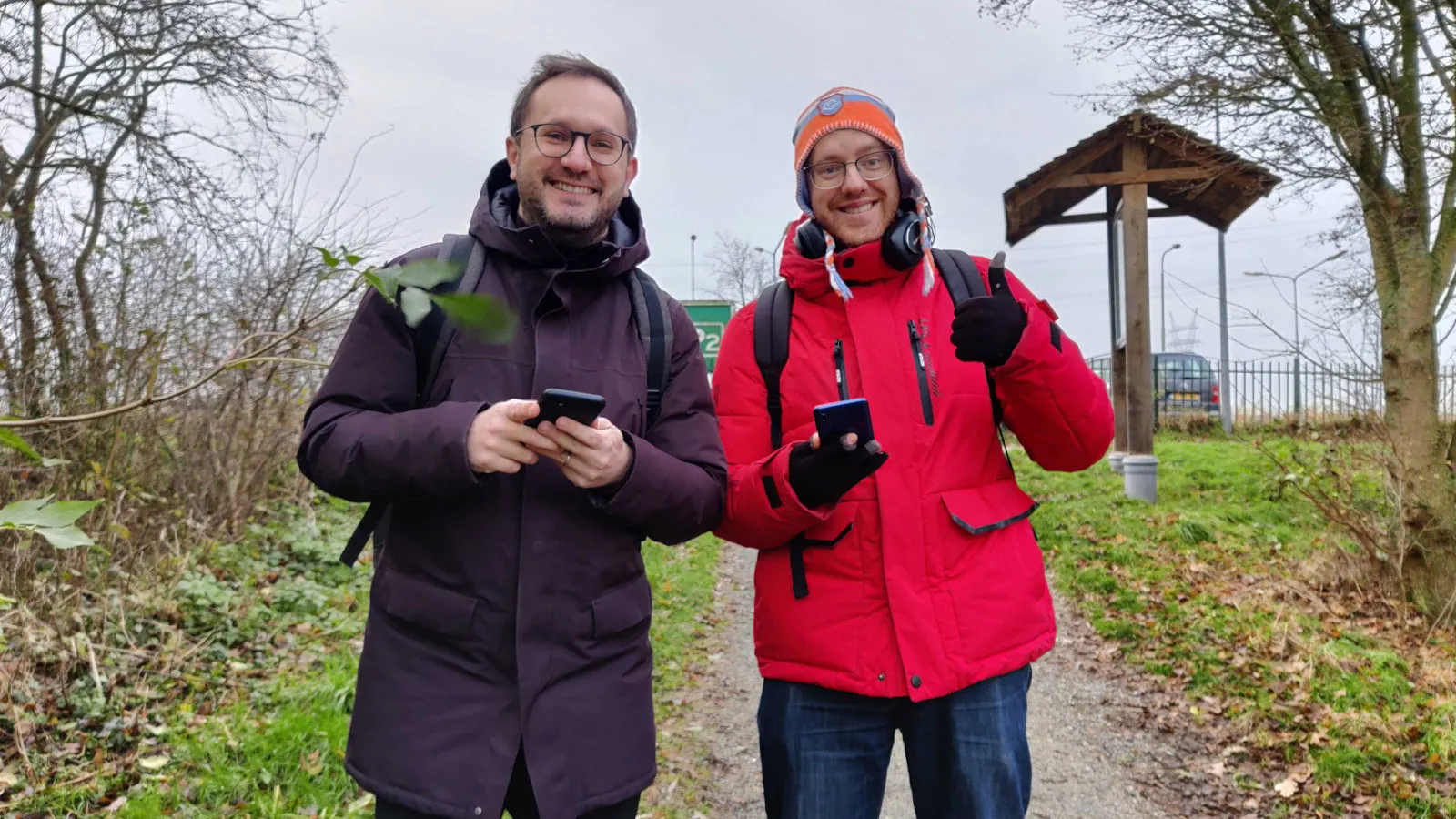
The Podwalks in the Podwalk app are GPS-guided audio tours at ten unique locations. These locations are linked to stories from Dutch history. Elements designed and developed the app that lets walkers step into the past. During the walk, Daan Schuurmans, the narrator of the documentary series, tells the historical story at the exact location where it took place.
For example, you hear how the Black Death ravaged Deventer in the Middle Ages, while around you the traces and remains of that period can still be seen. The app quickly proved to be a success: after the third episode of ‘The Story of the Netherlands’, the app had already reached the milestone of 100,000 downloads, and many people had already walked the routes past historical locations.
“The idea behind the app,” Theun explains, “was that the Netherlands should become one big open-air museum. To make the Podwalk experience as intense as possible, we wanted an app that required as little screen interaction as possible, unlike apps that are designed for maximum interaction. In practice, you should be able to activate a starting point, put your phone in your pocket, and not have to touch it again. That required a completely different way of thinking during the development of the Podwalk app.
The routes are plotted along specific GPS points that are activated when you are actually there. A great ambition, but when you put a phone in your pocket, that affects the GPS signal. The same applies when you walk through a tunnel. The Elements project team had to handle that intelligently while developing the app.
Another challenge was that the content had to be central to the app. It creates the experience and provides the substance, allowing users to look at their surroundings through the right lens. That means, on the one hand, that the story you hear really has to take you into history, and on the other hand, that the audio tracks had to be timed precisely so that you hear the content in the right place.
Television makers are specialists in telling stories to an audience, but how do you deal with differences in walking pace? An average walker moves at about five kilometers per hour, but some people walk much faster. When that happens, you do not want them wondering whether something is wrong with the app because it suddenly goes silent. So, in addition to various sound effects during a story, we also developed a loop track. This helps people keep walking and focus on their surroundings without taking out their device. When you reach the next GPS point, the next track starts.”
“We also had to find answers to questions such as: what happens if you take a wrong turn? Or if the audio does not start automatically at a certain point? Or if a tree suddenly blocks the path and you temporarily cannot reach a point?” Erwin adds. For these kinds of unhappy flows, you want to come up with a solution in advance. The route is locked: you cannot listen to it from your couch at home.
For example, we decided that, in addition to locking the route itself, we also needed to lock the individual GPS points along the route. This made sure that once you had reached one point, you could also unlock the next point if something unexpected happened. You can then skip that GPS point during the walk, while still listening to the audio, so you do not have to stop your walk altogether.
Of course, your phone is also in your pocket the whole time, while all kinds of processes are running in the background. That created quite a few challenges, because you do not want your phone battery to suddenly run out because you are using the Podwalk app. And even though the Podwalk app is mostly in your pocket, you still want to be able to control certain aspects of the app from your phone’s home screen. For example, you may want to pause the app if you want to look around somewhere a little longer, have lunch along the way, or take time to shoot some photos.”
Theun continues: “I learned a great deal from working with Elements, and I think the reverse is also true. The entire project was really ‘learn as you go’. For example, we quickly discovered that on-location testing is crucial for an app like this. Not only because of the routes and GPS points, but also because of the content. But how do you start testing when there is no app yet?
So we decided to create a kind of test tool, where we could attach a simple version of the content to the GPS points along the route. That was the only way we could check whether the GPS points were in the right places and whether the audio tracks were long enough. Elements then built that test app in a few days. It did not work perfectly, but the team could now assemble all the routes.
At the same time, we were developing the final Podwalk app at full speed, because we had a tight deadline, and we incorporated the lessons from the test app into that work. For example, it turned out that the experience in the studio is very different from the experience on location: sometimes more context is simply needed, because something that seems completely logical on paper only causes confusion in practice. The Elements team also occasionally really put pressure on me: “You have to make a decision about this or that now!” Or: “We are entering this phase now: that means you can no longer go back on…” I learned an enormous amount from that too!”
“At the beginning of January, we delivered the first version of the app,” Erwin says. “That was our version 1.01. And although we had, of course, tested the app extensively beforehand, we knew in advance that there would always be things we had not accounted for during development. The app was quickly downloaded 100,000 times, and the first people started walking the routes. Initially, that meant 1,500 walkers, but by now there are already 25,000 walkers and more than 200,000 downloads. Suddenly, you also get a huge group of testers.”
Theun laughs and adds: “We received criticism almost immediately: why are there no routes in Limburg? The answer to that is quite simple: we had to make choices and could not include everything in the app. But there were also comments about app features that did not work entirely as expected. We are, of course, trying to improve those. The app is also full of measurement points that provide a lot of useful data about how the app functions. That is very helpful, because with that data and the reviews, we were quickly able to launch a new version with many improvements.”
“The Podwalk app is for everyone in the Netherlands. That means, of course, that it is easy to use and does not have a steep learning curve. But it also means that extra attention has been paid to accessibility. The text size is scalable, making it easier to read. There is support for high contrast, and the app, which is available for both iOS and Android, can be used in dark mode for a better experience in lower-light environments. And since we mainly use the user’s location data in the app, we also had to take privacy into account, as well as the way we collect and store data. That is why Elements added a security officer to the project team: we want everyone to be able to use the app safely and for the necessary data processing to be clear to users!” Erwin concludes.
.webp)